

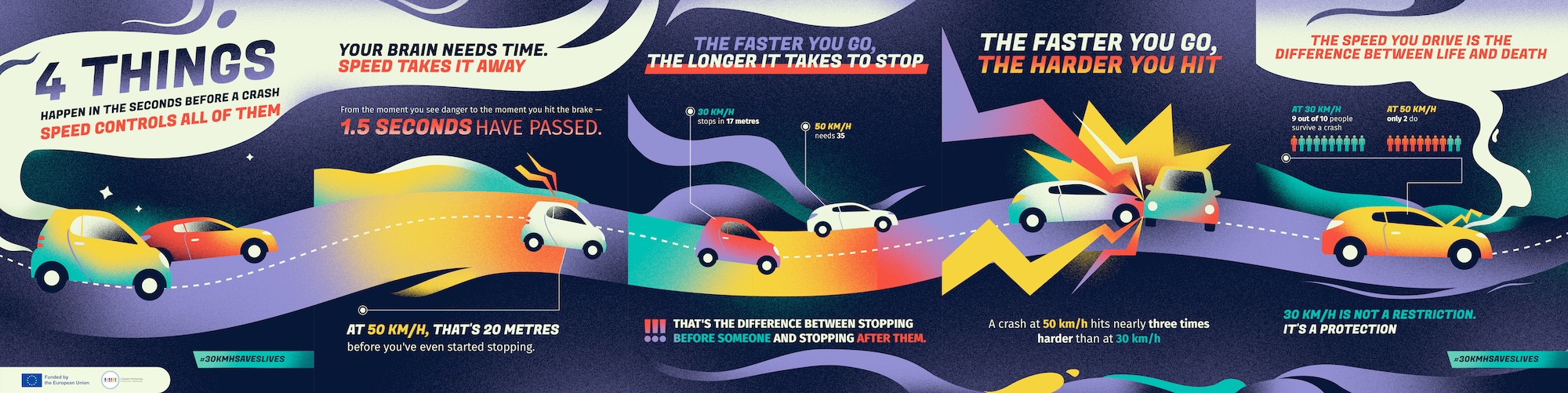
We are delighted to be launching ‘30 km/h Saves Lives,’ a 12-month digital media campaign covering Eastern Partnership (EaP) countries. We are calling on national and local governments, civil society organisations, businesses, and individuals to join the effort by sharing campaign materials in their own networks and communities.
The campaign combines joint social media messaging translated into local languages with country-specific content to promote the benefits of 30 km/h speed limits in urban areas, and to help residents understand why safer speeds save lives.
Urban traffic speed is one of the most important factors shaping road safety in cities and is a core component of the Global Plan for the UN Decade of Action for Road Safety 2021–2030. Road traffic injuries remain a major public safety challenge across many cities in the Eastern Partnership region, with regional fatality rates more than twice as high as the European average.
Reducing urban speed limits to 30 km/h has proven to significantly improve safety for pedestrians, cyclists, and other vulnerable road users in cities worldwide. World Bank Road Safety Country Profiles for Armenia, Georgia and Moldova estimate that fatal road crashes could fall by as much as 94–97% when recommended safe speed limits are enforced.
“Even small differences in speed can determine whether a road crash results in a minor incident or a life-threatening injury,” said Corrine Vibert, Communications Lead of the EaP RSO. “This campaign reframes lower speed limits not as a restriction on drivers, but as a protection for people and communities, and we want as many partners as possible carrying that message forward with us.”
Campaign materials are organised around five thematic pillars that translate road safety research into accessible messages.
- Speed and Survival | Vehicle speed directly affects crash severity. Higher speeds increase braking distance, reduce reaction time, and significantly increase the risk of fatal injuries.
- Child and Pedestrian Safety | Children and pedestrians are among the most vulnerable road users, particularly near schools and residential areas. Lower speed limits significantly improve safety in these environments.
- Myths and Misconceptions | Public perception of speed management policies is often influenced by misconceptions related to travel time, congestion, or enforcement.
- Safer and More Liveable Cities | Lower speeds contribute to healthier urban environments by reducing noise, improving safety for walking and cycling, and creating more comfortable public spaces.
- Community Benefits | Safer speeds support calmer neighbourhoods, encourage active mobility, and contribute to better quality of life in urban communities.
All campaign materials — social media assets, captions, and key messages — are provided free of charge in English and local languages.
Materials for the first theme, ‘Speed and Survival,’ are available now to use and adapt as often as desired, with four more released over the course of the campaign.


