

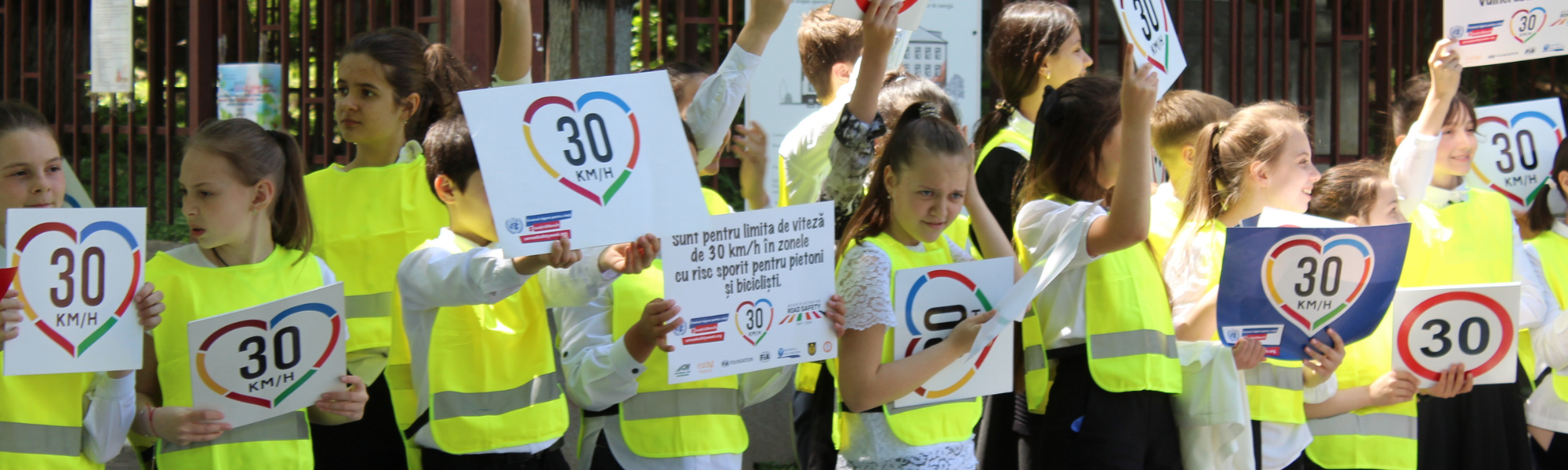
Every year, the roads of Armenia, Azerbaijan, Georgia, Moldova and Ukraine claim thousands of lives and leave tens of thousands more with life-changing injuries. The scale of this crisis is enormous, yet road safety remains underrepresented on the agendas of many civil society organisations (CSOs) working across the region.
In 2022, the Eastern Partnership Road Safety Observatory (EaP RSO) published a report entitled ‘Civil Society: Road Safety Engagement in the Eastern Partnership Countries’ that is just as relevant, if not more so, today as we mark International NGO Day 2026. The report makes a compelling case that road safety is not a niche concern, but a thread running through almost every area of public policy and therefore very much of interest to civil society organisations working across different sectors and issue areas.
One of the Observatory's core missions is to strengthen road safety data collection, reliability and analysis across the region, building the shared evidence base that governments and civil society alike need to make the case for investment and reform. In contexts where official data is incomplete or underreported, which the World Bank has estimated it to be by as much as 14–22% across EaP countries, CSOs that engage with data collection, local monitoring and transparent reporting are not filling a gap at the margins. They are doing work that sits at the heart of the entire road safety effort.
Road safety is everyone's issue
The UN Sustainable Development Goals include two specific road safety targets: SDG 3.6 calls for a 50% reduction in road deaths and injuries by 2030, while SDG 11.2 calls for safe, accessible transport for all. But the EaP RSO civil society report goes further, mapping how road safety intersects with no fewer than 13 of the 17 SDGs.
Organisations working on poverty alleviation should note that road crashes are a leading cause of household income loss, job insecurity and family breakdown. Those focused on gender equality should understand that girls and women face specific and heightened risks on roads across all forms of transport, risks that curtail their economic and social opportunities. Disability organisations, environmental groups, youth advocates and community development CSOs are all stakeholders in safer roads, whether they recognise it or not.
The economic cost alone is staggering. Road crashes cost Armenia an estimated 5.7% of GDP, Ukraine 4.7%, and Georgia 5.3% - losses that dwarf many other development challenges and that fall hardest on the most vulnerable.
The Safe System Approach: A framework for action
Underpinning the global effort to reduce road casualties is the Safe System Approach, which forms the basis of the UN Global Plan for the Decade of Action on Road Safety 2021–2030. Rather than placing blame on individual road users, this approach recognises that crashes are the result of system failures in road design, vehicle safety, enforcement, speed management, and emergency response - and that all of these systems must be addressed together.
Vision Zero, the ambition that no one should die on our roads, is achievable. Oslo and Helsinki both recorded zero pedestrian and cyclist fatalities in 2019, but Helsinki has since gone further still. In 2024, the Finnish capital went an entire year without a single road death of any kind, with traffic-related injuries falling dramatically in the same period.[1] This was achieved through a combination of city-wide 30 km/h speed limits, over 1,500 km of cycling infrastructure, expanded public transport, and automated enforcement as well as a sustained, systemic effort across government, the private sector and civil society.
What CSOs are already achieving
The EaP RSO report highlights five country-level case studies that demonstrate what civil society can accomplish when it engages strategically with road safety.
In Armenia, the National Road Safety Council NGO worked with the Traffic Police, Yerevan city authorities, EASST and the Safer Roads Foundation to redesign a high-risk roundabout on the Artashat Highway that had recorded 20 serious injuries and one fatality between 2016 and 2021. Police crash data drove the case for investment, and the completed scheme, which included a new roundabout, raised pedestrian crossings and high-visibility signage, has recorded zero casualties since its completion.
In Azerbaijan, the National Automobile Club (AMAK) conducted the country's first pedestrian safety research project in 2017 and created an interactive crash data map for Baku in 2021, identifying five priority corridors and submitting concrete recommendations to local decision-makers. The project was built on a new collaboration with the Traffic Police around data sharing - a breakthrough in itself.
In Georgia, the Partnership for Road Safety played a central role in transforming Tbilisi's Chavchavadze Avenue from a dangerous, car-dominated road into the city's first pedestrian-friendly shared street, with reduced speed limits, accessible crossings and Bus Rapid Transit. The same NGO translated and promoted the Global Designing Cities Initiative (GDCI) Urban Street Design Guide, which is now actively used by the city's Transport Development Agency.
In Moldova, the Automobile Club of Moldova created baby4baby.org, a web platform enabling families to donate and share child car seats - a response to the fact that a seat costs more than the average monthly wage. Over 760 seats have been redistributed to low-income families, accompanied by a national advocacy campaign.
In Ukraine, Impact NGO partnered with UK-based FIRE AID and EASST to donate fire appliances, personal protective equipment and road traffic extrication kits to emergency services, alongside training programmes that for the first time brought police, fire and ambulance services together to coordinate post-crash response.
Common challenges - and how to overcome them
The report is also candid about the barriers holding civil society back. These include a silo mentality between agencies, unreliable crash data, donor-driven priorities that favour visible but low-impact activities, a tendency to focus on children's education rather than infrastructure, and a persistent culture of blaming road users rather than fixing systems.
One under appreciated barrier is the tendency for CSOs to work in isolation. Road safety organisations campaigning alone are far less effective than coalitions of organisations (including health groups, disability advocates, environmental CSOs, and/or youth networks) pushing in the same direction at the same time. The most significant policy shifts in road safety have rarely been won by a single organisation; they have been the result of sustained, broad-based pressure that made reform feel politically inevitable. Building those coalitions across sectors is one of the most strategic investments EaP civil society can make.
Equally important is the role CSOs can play as producers of evidence, not just consumers of it. The Azerbaijan case study is a good example: rather than waiting for government data, AMAK generated its own crash mapping, created an evidence base that didn't previously exist, and used it to make an unanswerable case for intervention. In contexts where official data is incomplete or unreliable this kind of community-led research is not just useful, it is essential. This is precisely the kind of contribution the EaP RSO was established to support and scale.
A call to engage
Ultimately, governments are accountable to the communities most affected by dangerous roads — but that accountability depends on those communities having an effective voice. CSOs provide that voice. They represent road crash victims and their families, people with disabilities, and the many others for whom unsafe roads are not an abstract policy problem but a daily reality. That representative function matters as much as technical expertise, and it is one that no government agency or international body can replicate.
The 2030 deadline for halving road deaths and serious injuries across the Eastern Partnership is approaching fast. For CSOs yet to engage with road safety — whatever their primary focus — the case for doing so has rarely been clearer or better supported.
This editorial draws on the EaP RSO report "Civil Society Road Safety Engagement in the Eastern Partnership Countries" (September 2022).
Photo: Automobile Club of Moldova


